Strategic sales pipeline management for professional services
CRM
Professional Services
Strategic sales pipeline management for professional services
Senior leaders rarely question the effort their teams invest. The real question is whether that effort creates meaningful commercial movement. In many firms the answer is unclear. Pipelines are fragmented, partner involvement varies and core data sits in spreadsheets that were never designed to support strategic decisions.
The absence of structure means leaders cannot see whether activity is shifting weighted pipeline value, improving conversion velocity or reducing deal stage ageing. These indicators, which HubSpot surfaces through custom deal reports and behaviour-based scoring, reveal whether the investment of time is creating genuine momentum or simply generating noise.
When we see firms shift from manual activity tracking to structured sales pipeline management, the change is not tactical. It alters how the organisation understands demand, prioritises capacity and allocates fee-earner attention. It creates a shared view of commercial momentum that informs both operational planning and long-term growth.
A tiered upsell pipeline is often the simplest starting point. It forces alignment around value, readiness and accountability.
What actually holds sales pipeline management back in professional services?
The barriers are rarely about technology. They sit in behaviour, structure and expectation.
Diffuse ownership. When everyone is responsible for client development, no one has visibility of where opportunities sit or who is moving them forward.
Partner-driven variability. Different styles and working preferences often mask gaps in process, leading to inconsistent data and unpredictable forecasts.
Limited commercial insight. Without a unified pipeline, leaders cannot determine which activities influence utilisation or where margin is at risk.
These issues compound. Decisions become anecdotal. Teams work hard but patterns remain hidden.
How a tiered upsell pipeline strengthens strategic sales pipeline management
A tiered upsell pipeline gives leaders a predictable mechanism for prioritising accounts, sequencing activity and assessing commercial readiness, which in turn sharpens forecasting and enables more intentional use of partner and BD time.
A tiered upsell pipeline does more than highlight priority accounts. It forces the firm to design a pipeline architecture that supports governance, forecasting and behavioural consistency across partners and BD.
Configuring a strategic pipeline framework in HubSpot
A well-architected pipeline is not just a reporting tool. It becomes the operating framework that shapes how commercial decisions are made. In HubSpot, this begins by aligning the pipeline with the realities of a Professional Services lifecycle.
- Defining pipeline stages that mirror the client journey
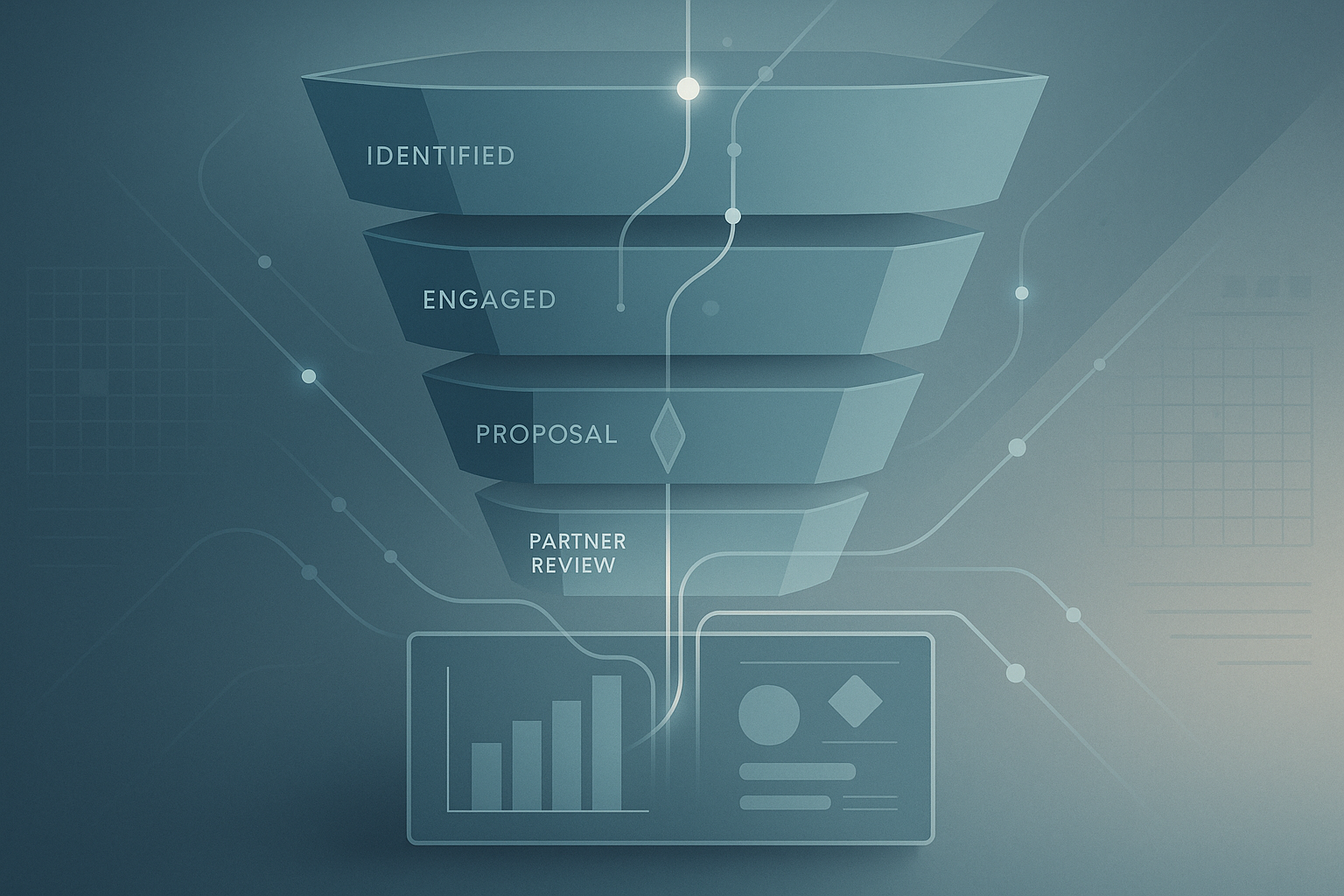
Stages such as Identified, Engaged, Proposal, Partner Review, Closed Won and Closed Lost provide a shared language for opportunity movement. This reduces ambiguity and supports consistent partner participation. - Adding weighted probabilities to create forecasting benchmarks
Weighted stages give leaders a more reliable view of expected revenue and highlight where assumptions are out of line with observed conversion patterns. - Applying custom properties to support deal tiering
Fields such as tier_value and readiness_score ensure the system reflects both commercial potential and behavioural signals. This strengthens prioritisation and keeps senior attention focused where it creates leverage. - Automating ownership rules to reduce friction
Workflows that assign Partners, BD or Delivery based on stage progression turn the pipeline into a governance model rather than a static list. Teams gain clarity on who acts next, and leaders gain confidence that opportunities keep moving.
What senior leaders typically see when structure replaces intuition
Patterns emerge quickly once a firm adopts a disciplined pipeline:
- More predictable utilisation due to tighter oversight of expansion opportunities
- Higher retention and expansion across priority accounts
- Partners spending time where it creates commercial leverage rather than noise
- More coherent quarterly planning, as pipeline signals align with delivery capacity
- A culture that becomes less reactive because decisions rely on shared data, not individual memory
The value is cumulative. The more consistently the pipeline operates, the more confident leaders become in directing investment, resource planning and BD focus.
Why this matters for growth, not just reporting
Most Professional Services firms do not struggle with effort. They struggle with visibility and consistency. Structured sales pipeline management creates a commercial rhythm that sits above individual working styles and gives the firm a single version of truth.
It also reduces the political friction around BD. When the system shows where momentum sits, debates shift from opinion to evidence. Leaders can then shape growth strategies with clarity rather than compromise.
A tiered upsell pipeline is not a workflow change
It is an operating choice that surfaces risk earlier, concentrates effort where it matters and helps leaders turn insight into income with far more precision. If you want to understand how your current pipeline supports or constrains growth, start by mapping where decisions rely on instinct rather than evidence.